Plan a capsule from your calendar
Translate two ordinary weeks into outfit roles, repeatable formulas, color connections, and a laundry rhythm before choosing a target item count.
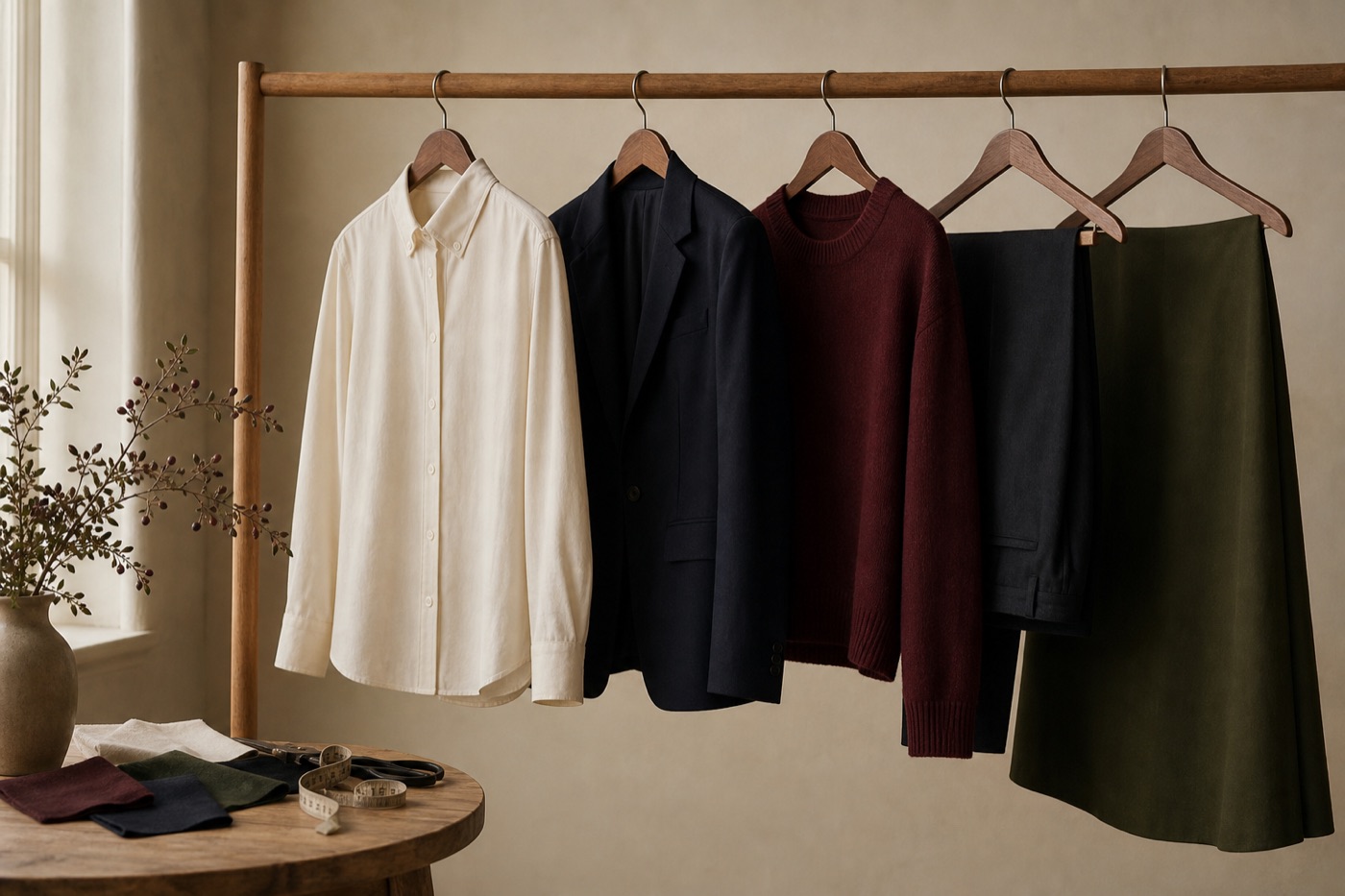
Audit two normal weeks
Begin with fourteen days that resemble ordinary life rather than a holiday or ideal future. Record the activity, dress expectation, climate exposure, movement, duration, and whether you can repeat an outfit. Separate “work” into actual conditions: desk with strong air conditioning, outdoor appointments, uniformed service, video calls, or formal meetings require different layers and footwear.
Mark high-frequency roles and rare roles. If ten of fourteen days require a comfortable base plus a polished layer, that formula deserves more support than an occasional event dress. Include travel time, school runs, exercise, care work, religious or cultural requirements, and weather transitions. The calendar is evidence about demand.
| Entity | Attribute | Example value | Wardrobe implication |
|---|---|---|---|
| Weekday | Primary role | Office, 3 days | Two bottoms, three tops, one layer can rotate |
| Climate | Variation | Cool morning, warm afternoon | Removable light layer |
| Laundry | Interval | Every 7 days | Enough washable bases for the cycle |
| Movement | Demand | Walking and sitting | Test stride, rise, knee, and waist comfort |
| Event | Frequency | Monthly dinner | One reliable elevated formula, not weekly volume |
Convert activities into outfit formulas
An outfit formula describes functions rather than specific products: fitted base + relaxed trouser + structured layer; dress + flat shoe + weather layer; knit + straight denim + coat. Formulas make gaps visible without requiring every look to match exactly. List the formulas that solve at least eighty percent of the recorded situations.
For each formula, identify the bottleneck. You may own many tops but only one bottom compatible with the required shoes, or several jackets that cannot layer over the knit worn in winter. A bottleneck is more informative than a category count. Link each candidate item to at least one high-frequency formula and test it with the movement and fit sequence.
Formula test
- Name the situation and required level of formality.
- Select a base, bottom or one-piece, shoe, and weather layer.
- Check movement, temperature, and care after the expected duration.
- Photograph or write the successful combination.
- Repeat the formula with one substitution; if no substitution works, record the bottleneck.
Build color bridges and silhouette options
A useful palette has connections. Choose one or two base colors already present in expensive or slow-to-replace items such as coats, shoes, and bags. Add bridge colors that work with both bases, then accents you genuinely wear near the face or across a larger area. A print can act as a bridge when it includes existing colors.
Silhouette also needs connection. If all tops are long and all bottoms need a visible waist, the pieces may be individually attractive but systemically awkward. Record preferred volume combinations—close top with wide bottom, relaxed top with straight bottom—and make sure layers fit over the actual sleeve and shoulder shapes underneath. Proportion is a relationship among garments and wearer, not a body rule.
Coat, shoes, core bottoms
Tops and layers connect bases
Color or print you repeat
Whole formulas for roles
Use an inventory matrix, not a purge pile
Lay out or list the garments supporting each role. Score use frequency, current fit, textile suitability, care feasibility, condition, and number of complete outfits. Do not discard an item merely because it has not been worn during the wrong season. Move uncertain pieces into a trial group with a date and a concrete test.
| Item | Roles | Outfits now | Care cycle | Condition | Decision |
|---|---|---|---|---|---|
| Navy blazer | Office, dinner | 4 | Brush, air, periodic cleaner | Good | Core |
| Cream shirt | Office, casual | 5 | Weekly wash, air dry | Cuff wear | Repair and keep |
| Olive skirt | Office, dinner | 3 | Wash per label | Good | Core bridge |
| Bright top | Social | 1 | Easy | Good | 30-day outfit trial |
The matrix protects against “minimalist” replacement shopping. A repaired item already integrated into five outfits may be more valuable than a new perfect-looking basic. Use the care guide to estimate whether maintenance can extend its role.
Apply a fail-closed gap test
A gap is a repeated unsolved role, not a category that an online checklist says you should own. Before buying, write the role, formula, climate, minimum fit anchors, material constraints, acceptable care, and three outfits using existing pieces. Search against that brief. If a candidate solves only one outfit by requiring another purchase, it has not closed the gap.
After purchase, test within the return window using the intended shoes, underlayers, coat, seated position, and real indoor light. Keep the item only if it resolves the documented bottleneck without creating a care or coordination problem you are unwilling to support.
Sources and further reading
These references support the standards and factual claims in this guide. The decision frameworks and worked examples are original editorial synthesis.
Questions practitioners ask
How many pieces belong in a capsule?
There is no universal number. Count the roles and laundry intervals your real calendar requires, then add only enough flexibility for weather, repetition, and maintenance.
Must every color be neutral?
No. A capsule needs connection, not beige. Repeating a small number of base, bridge, and accent colors can create coordination with strong color.
Should shoes and outerwear count?
Include them in the planning system because they can make an outfit usable or unusable, even if you keep a separate item count.